
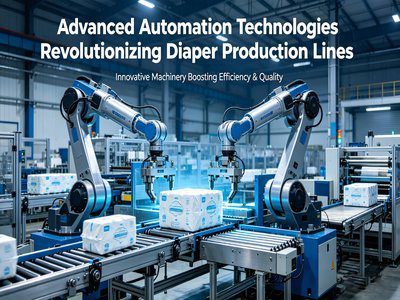
Advanced Automation Technologies Revolutionizing Diaper Production Lines
The global diaper manufacturing industry is undergoing a profound transformation driven by rapid advancements in automation technologies. By 2026, successful manufacturers are embracing full-servo drives and Industry 4.0 platforms.
Full-servo drive systems have fundamentally reshaped production lines. Unlike traditional mechanically driven lines, servo motors control every critical stage—material unwinding, core formation, cutting, folding, and packaging. Modern diaper equipment now operates at speeds of 600–1,000+ pieces per minute, up from 300–500 a decade ago. Servo-driven lines achieve millimeter-level parameter control, with SAP/fluff mixing ratios accurate to ±0.5g and cutting precision within ±1mm.
Industry 4.0 integration turns lines into intelligent ecosystems. IoT sensors enable real-time machine health monitoring and predictive maintenance, reducing costly unplanned downtime. Manufacturing Execution Systems track OEE, helping optimize workflows. Vision inspection systems with high-speed cameras detect surface defects at over 200 pieces per minute, achieving misjudgment rates below 0.1% and auto-rejection of defective products. Quality pass rates have reportedly increased from 75% to 98% after implementing these systems.
Chinese hygiene equipment manufacturers are at the forefront. A Quanzhou-based manufacturer holds over 100 core patents and has built a complete intelligent production system. Another leader in pet hygiene products operates over 60 fully automated lines across two bases, integrating full-servo drives with metal detectors, weight sensors, and vision systems, forming a closed-loop quality management framework. It also reduced energy consumption by 15% using variable-frequency motors and waste heat recovery.
The full-servo baby diaper machine market was valued at ~$450.5 million in 2024 and is projected to reach $823.7 million by 2032 (CAGR 7.1%). Asia-Pacific holds 38.4% share, with China alone at 21.5%. Disposable baby diapers represent the largest segment at 56.3%.
Key trends include AI-driven maintenance prediction and quality control, shift toward machines supporting eco-friendly and biodegradable diaper production, modular designs for easy customization, and systems handling broader raw materials like organic cotton.
One manufacturer implementing IoT digital transformation achieved a 23% reduction in scrap on a diaper line, saving ~2 million diapers or $250,000 annually, with ROI under two years. It also delivered a 3% OEE increase and eliminated 5 tons of paper by digitizing forms.
Integration of full-servo automation, IoT predictive maintenance, real-time inspection, and sustainable practices will define the competitive landscape. Manufacturers investing comprehensively in automation today will capture market share, control costs, and deliver consistent quality.