
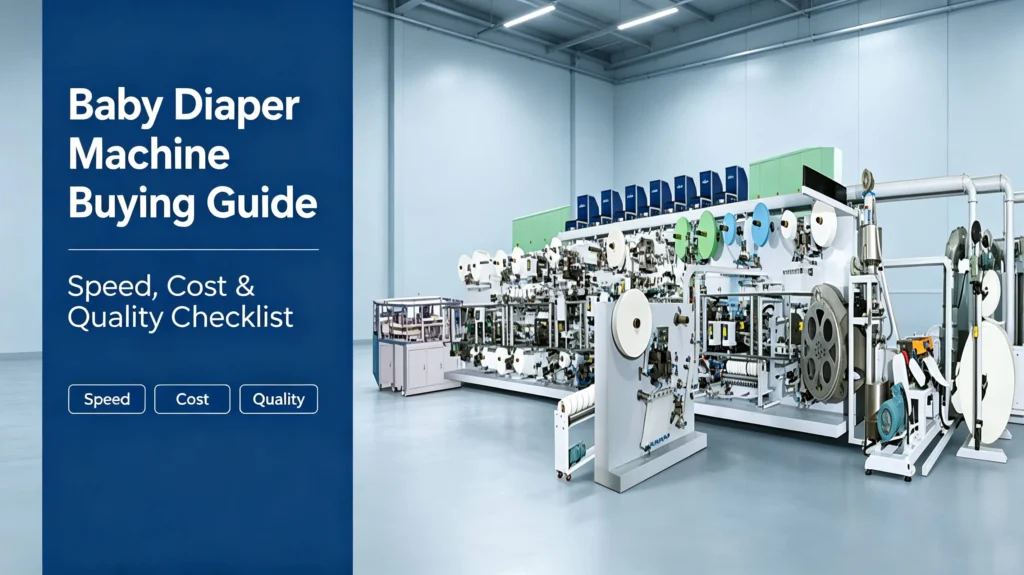
Baby Diaper Machine Buying Guide: Speed, Cost & Quality Checklist
Baby Diaper Production Line Buyer’s Guide: 15-Point Checklist Before You Quote
TL;DR: Most mistakes when buying a baby diaper production line happen before the quote, not after. Buyers who lose money usually skip three things: seeing the machine run in person, mapping the full cost instead of just the machine price, and putting after-sales terms into the contract. This guide gives you a 15-point checklist covering speed, quality, cost, and support — so you can compare suppliers on facts instead of sales talk.
Why Buyers Overpay or Get Burned
One pattern shows up again and again with buyers in Southeast Asia, the Middle East, and Latin America: they compare machines on two numbers only — pieces per minute (ppm) and the sticker price — and ignore everything else that determines whether the machine actually makes money.
A machine that runs 20% faster but stops for repairs twice as often is a worse investment. A machine that is $30,000 cheaper but needs $60,000 in rework and spare parts in year one is not cheap. This guide is for buyers comparing a baby diaper production line who want a repeatable way to judge suppliers.
1. What Production Speed Do You Actually Need?
The real question is not “which machine is fastest” — it is “which speed matches your sales.”
- Startup buyers usually need 150–250 ppm. Enough to start production while keeping capital cost and operator requirements manageable.
- Mid-size buyers scaling an existing brand typically target 250–450 ppm.
- High-volume OEM players run 450–800 ppm or more, often on multi-lane lines, where output per shift matters more than the per-minute number.
How to apply this: work backward from your monthly sales target. If you need 20 million pieces a month, calculate ppm × operating hours × efficiency, then add 15–20% for line changes and maintenance. Buy too slow and you cannot scale; buy too fast and you pay for capacity you will not use — and need more skilled operators.
2. How Do You Verify Machine Quality Before Buying a Baby Diaper Production Line?
This is the step most buyers skip, and the most expensive one to skip.
- Ask for a factory trial (FAT) or a live video run. A serious supplier can show a real machine running real material at the quoted speed. If they cannot or will not, treat that as a signal.
- Check the core components. Servo motors, the PLC (Siemens, Mitsubishi, etc.), the hot melt system, and the cutting units drive reliability. Ask for the component brand list — not just the machine brand.
- Ask about the frame and rollers. Rigidity and roller precision determine long-term consistency of product quality and how often you need to re-align.
- Request reference customers in your region or producing the same product type, and ask them directly about downtime.
For industry context, the European Disposables and Nonwovens Association (EDANA) publishes useful market and technical resources for hygiene manufacturers.
3. What Is the Real Cost Structure?
The machine price is only part of the cost. Ask for a full breakdown:
| Cost item | What to check |
|---|---|
| Machine price | Base line + configuration, not a vague package |
| Installation & commissioning | Who travels, who pays, how long until stable output |
| Raw material trial cost | Who provides the SAP, fluff pulp, and nonwoven for the trial |
| Spare parts | Wear parts (cutters, sealing parts) — cost and lead time |
| Training | Operator + maintenance training, on site or remote |
| After-sales | Warranty scope, response time, spare parts availability |

A useful rule: budget the first year’s total cost — machine + installation + spares + training + trial materials — not the machine price alone. That is the number to compare across suppliers.
4. What After-Sales Support Should You Demand?
A baby diaper production line is a 5–10 year asset. Get these into the contract:
- Warranty period and exactly which parts are covered.
- Response time for breakdowns — do they offer remote video diagnosis? How fast can an engineer arrive?
- Spare parts lead time — some suppliers ship in days, others in months. Ask for a written parts list with lead times.
- Software / PLC updates — is programming support included, or billed separately?
Verbal promises disappear. Contract terms are enforceable.
5. Which Raw Materials Affect Line Efficiency?
A machine is only as good as the material it runs. Buyers often blame the machine when the real problem is a material mismatch:
- SAP (super absorbent polymer) and fluff pulp directly affect absorption and forming speed.
- Nonwoven and film quality affects sealing and finished-product appearance.
- Hot melt adhesive affects bonding strength and line speed.
Ask which material specs the machine is tuned for, and test your actual materials during the trial — not the supplier’s demo material. For a deeper cost analysis, see our diaper raw material cost guide.
6. The 15-Point Checklist for a Baby Diaper Production Line
- Confirm the ppm you need from your sales target, with a buffer.
- Get the full component brand list (servo, PLC, hot melt, cutter).
- Verify with a factory trial or live video on real material.
- Ask for reference customers in your region.
- Get a first-year total cost breakdown, not just the machine price.
- Confirm installation & commissioning responsibility and cost.
- Confirm who provides the trial materials.
- Get a written spare parts list with lead times.
- Lock warranty scope and response time into the contract.
- Confirm operator & maintenance training (on site or remote).
- Ask which material specs the machine is tuned for.
- Check power, air, and space requirements at your site.
- Confirm voltage and local standards compatibility.
- Agree on acceptance criteria — what output/quality counts as “done.”
- Confirm payment terms and stage payments tied to milestones.
7. The Mistakes That Cost Buyers the Most
- Buying on price alone. The cheapest line is rarely the cheapest to own.
- Skipping the factory trial. You cannot verify reliability from a brochure.
- Ignoring material compatibility. The machine and material must be tested together.
- Vague after-sales terms. If it is not written down, it does not exist.
- No acceptance criteria. Without agreed output and quality targets, disputes are guaranteed.
Frequently Asked Questions About Baby Diaper Production Lines
What is the typical speed of a baby diaper production line?
Startup lines usually run 150–250 ppm. Mid-size operations run 250–450 ppm. High-volume OEM lines can run 450–800 ppm or more. The right speed depends on your monthly sales target and operating model.
How much does a baby diaper production line cost?
Machine price varies widely by speed, automation, and component brands. Always compare the first-year total cost: machine, installation, spare parts, training, and trial materials. A cheaper machine can cost more if it needs frequent repairs or slow changeovers.
What should be included in after-sales support?
Contract terms should include warranty scope, response time, remote diagnosis, spare parts lead times, and training. Verbal promises are not enough.
How do I verify machine quality before buying?
Ask for a factory trial or live video run on real material. Check the component brand list, reference customers, and after-sales terms. Do not rely only on a brochure or showroom demo.
About Us
Quanzhou Loeon Trading is based in Quanzhou, Fujian — the largest hygiene-product equipment manufacturing cluster in China. We work with local production-line and parts manufacturers to help overseas buyers source machines, spare parts, and raw materials in one place, and to coordinate factory trials, commissioning, and after-sales support.
If you are comparing baby diaper production lines, contact us with your target ppm and monthly volume — we will help you build a comparison on real numbers.
Contact: jenny@qzloeon.com | WhatsApp: +86 13338566167 | www.qzloeon.com
Quanzhou Loeon Trading Co., Ltd. provides supply chain services for hygiene product manufacturers worldwide, including equipment sourcing, raw materials, spare parts, and OEM support. Based in Quanzhou, Fujian, China.