
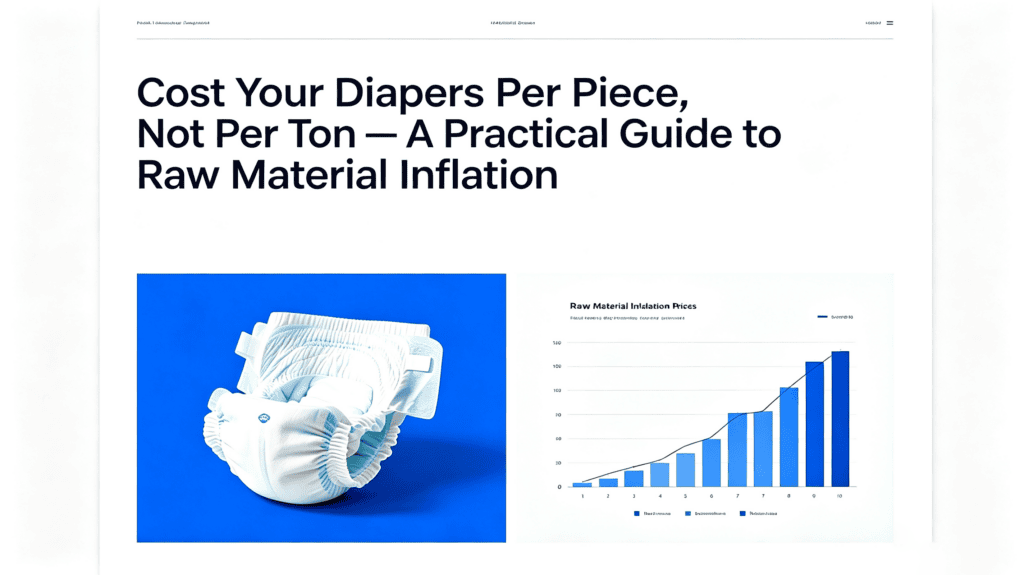
Cost Your Diapers Per Piece, Not Per Ton
Diaper Raw Material Costs Guide: Cost Per Piece vs Per Ton
Raw material prices for diapers have jumped. Since March, every material has moved: PP nonwoven up 30–35%, SAP up 15–20%, hot melt up 20%, PE film up 18–25%, and fluff pulp up 10–12%. Managing diaper raw material costs is now critical for every manufacturer.
A medium‑sized line pumping out 10 million pieces a month — the math isn’t complicated. Your raw material bill just went up somewhere between $30,000 and $50,000. Every month. For some factories, that’s the entire profit — gone.
I’m not going to tell you there’s a magic fix. There isn’t. But there are things you can do that most factories aren’t doing yet. That’s what this guide is about.
Common Mistakes in Managing Diaper Raw Material Costs
I’ve watched factories make the same three moves every time raw material prices spike. All three make things worse.
1. Buying the cheapest version of everything
You swap to a lower‑grade SAP. Absorption tanks. Leakage complaints start coming in. Returns pile up. And here’s the part nobody calculates until it’s too late — cheap SAP with inconsistent particle size jams your core‑forming unit. That machine you spent half a million on? It’s now running at 85% because the material is fighting the equipment. You didn’t save money. You just moved the cost from procurement to the production line, with interest.
Last article I wrote was about buying equipment. This one’s about raw materials. But they’re the same conversation. Good machine, bad inputs — you paid for uptime you’re never going to see.
2. Panic‑buying a warehouse full of inventory
SAP degrades. Nonwovens don’t love humidity. Hot melt loses bond strength sitting around. So now you’ve tied up cash in materials that might underperform by the time they hit the line. One problem became two.
3. Passing the full increase to your customer
In some markets you can push through maybe 5–8%. In a competitive market? Maybe nothing. Your competitors are staring at the same cost pressure. The ones who figure out how to absorb more without wrecking their product — those are the ones who come out the other side bigger.
The Key Metric: Diaper Raw Material Costs Per Piece
Most factories buy by the ton and think in tons. Wrong number. You sell pieces. You should think in pieces.
Here’s a standard baby diaper, around 30 grams. The cost per piece, before and now:
| Material | Grams/Piece | Was | Now | Increase |
|---|---|---|---|---|
| Nonwoven (top + back) | ~8g | $0.0056 | $0.0076 | +35% |
| SAP | ~3.5g | $0.0063 | $0.0074 | +17.5% |
| PE Film | ~5g | $0.0025 | $0.0031 | +24% |
| Fluff Pulp | ~10g | $0.0035 | $0.0039 | +11% |
| Hot Melt + others | ~3.5g | $0.0021 | $0.0025 | +19% |
| Total per piece | ~30g | $0.0200 | $0.0245 | +22.5% |

That extra $0.0045 per piece? On 10 million pieces a month, that’s $45,000.
Now look at the table again. Everyone panics about SAP because SAP is the expensive line item. But nonwoven is the one that actually moved the most. PP spunbond is your biggest cost driver right now, not SAP. If you only have time to attack one thing, attack nonwoven.
Managing Diaper Raw Material Costs: Start with Nonwoven
Three things you can do this week.
- Drop a gram or two on the backsheet. I’m not saying make your diaper thinner — nobody wants leakage. But on the backsheet specifically, a 1–2 GSM reduction is invisible to the consumer. It saves 3–5% on total piece cost. Run 50,000 pieces. If nobody notices and nothing leaks, you just saved real money.
- Ask your supplier about PP/PET blends. Some mills now offer bicomponent spunbond that’s 5–8% cheaper than pure PP for the same hand feel and tensile. Availability depends on where you are, but it’s one phone call to find out.
- Split your nonwoven volume. Give 30% to a second supplier. Even if you don’t switch, the quotes you get will make your conversation with supplier #1 a lot more productive. This alone usually saves 3–5%.
SAP Strategy to Control Diaper Raw Material Costs
To manage diaper raw material costs effectively, the SAP grade you choose matters more than you think. Not every diaper position needs the same grade. A newborn diaper gets changed every two hours; an overnight toddler diaper handles more volume; an adult incontinence product deals with viscous fluid under body pressure. Different jobs, different specs.
Ask your SAP supplier this exact question: “What grade do you have that matches what my product actually needs — not the most expensive one you sell?”
Japanese SAP — Nippon Shokubai, Sumitomo — still owns the high end. Chinese producers like Satellite Chemical and Wanhua have closed the gap, especially for standard applications. For a basic baby diaper? You probably can’t tell the difference. For a premium adult product where absorption under pressure is everything? The Japanese grades still earn their premium.
Most factories are over‑spec’d and don’t know it. Figure out what you actually need, then buy exactly that.
Locking Prices to Stabilize Diaper Raw Material Costs
Fluff pulp moves slow. If you can lock 3–6 month pricing right now, do it. It’s your most predictable line item. Take the certainty.
SAP is usually quarterly. If your supplier offers a six‑month contract at current rates, think of it as insurance. Maybe crude drops by Q4 and you overpay a little. Maybe things escalate and you’re glad you locked.
Nonwoven and PE film track crude oil closest. Fixed contracts right now are expensive because suppliers are pricing in maximum uncertainty. You’re probably better off floating these and managing through the nonwoven strategies above.
And one more thing on suppliers: during the 2021–2022 supply chain mess, the factories that had relationships with multiple suppliers got allocation. The factories that didn’t got nothing. Even if you source 80% from your main guy, having a second relationship isn’t about price — it’s about survival when things get weird.
According to industry data from ICIS, polypropylene prices have been volatile since early 2026, reinforcing the need for agile procurement.
How Your Machine Affects Diaper Raw Material Costs
I wrote about equipment last time. Here’s where the two connect. Newer full‑servo lines — stuff built in the last 3–4 years — handle material variation way better than old mechanical lines. Servo‑driven tension control, adjustable ultrasonic bonding, programmable core‑forming parameters. Those features mean your machine can run a slightly lower GSM nonwoven, or a different SAP grade, without jamming every hour.
If your machine can handle a wider material window, you have options when prices move. If it can’t, you’re stuck buying exactly what the machine demands, at whatever price the market sets.
When you’re buying a machine: ask about material tolerance. When you’re running one: test the edges of that window. Carefully. Small batches. The difference between “this machine only runs Japanese SAP” and “this machine can run Chinese SAP with a parameter tweak” can be six figures a year at current prices.
Quanzhou Insights on Diaper Raw Material Costs
Our office is 30 minutes from more hygiene equipment and raw material suppliers than anywhere else on earth. A few things worth knowing:
- The big guys are fine. Plants doing 50 million pieces a month have leverage and long‑term contracts. They’re absorbing this better than anyone expected.
- The pain is in the middle. Factories running 5–20 million pieces a month. Big enough to feel it. Not big enough to command terms. That’s where the stress is.
- Some are getting creative. One factory we work with split their SAP supply: 60% Chinese for standard lines, 40% Japanese for premium. They saved about 12% on SAP. Zero quality complaints. The trick wasn’t the split — it was the three weeks of parallel testing before they committed.
Demand isn’t dropping. Nobody’s buying fewer diapers because SAP got expensive. This is a margin problem, not a volume problem. Margin problems have solutions.
And there might be a window. If crude stabilises in the second half of 2026, nonwoven and film could ease by Q4. The factories that get through this stretch without destroying quality or burning customers — they’re the ones that come out stronger.
Ultimately, controlling diaper raw material costs requires a combination of smart sourcing, machine optimisation, and per‑piece costing. The factories that master this will lead the market.
If you’re feeling the squeeze and want someone to bounce your numbers against, reach out. We do this every day: help diaper manufacturers sort out procurement, equipment, and production. Sometimes one conversation spots the $45,000 a month you didn’t know was there.
jenny@qzloeon.com | WhatsApp: +86 13338566167 | www.qzloeon.com
Quanzhou Loeon Trading Co., Ltd. — supply chain services for global hygiene manufacturers: equipment sourcing, raw materials, spare parts, and OEM support. Based in Quanzhou, Fujian.